Future of Education
EDU 505 FVE Final Project paper
The Future Vison of Education for Post University
FVE Final Project
Lynette Markey
Introduction
The future of education begins with the Universities and there will still be a need to educate instructors to the most current use of technologies so they can teach our youth. In order to look to the future it is necessary to look at the past and how education has evolved. Post University has such a rich history from 1890 to present times. The school serves a variety of educational levels from undergraduate through masters, many age groups from adults to youth fresh out of high school and works with military personnel both at home and deployed. The University offers a variety of majors and degrees to choose from. Post also offers face to face on campus learning as well as on line classes, there is a clear view of flexibility for future ways to educate. The University also offers athletic programs to round out the college experience. Post University Eagles are members of the NCAA and have many sports. Men’s include baseball, basketball, cross country, lacrosse, golf, soccer, ice hockey, tennis, sprint football, and track and field. Women’s sports include basketball, cross country, lacrosse, golf, ice hockey, soccer, softball, tennis, and volleyball and track and field. To stay connected with the community Post aids the Police Explorers, United Way, local duck race and EDAdvanced programs.
There is an impressive list of graduates from Post with a variety of degrees through out the years and the list proves Post’s mission statement to be accurate. Their mission is to “provide students with the knowledge, personal skills and experiences required to become leaders in their chosen careers. We prepare students to become confident, competent, and competitive participants in the global marketplace” (Post University, 2019). Some of Post University’s notable alumni are Jay Alix, founder of AlixPartners, Ron Christy, former Harlem Globetrotters, Kimberly (Burgess) Guisti, 1993 Miss Connecticut, Selim Noujaim, member of the Connecticut House of Representatives, Mario Abdo Benítez, president of Paraguay (Post University, 2019).
The future of education is and always will be in technology, how to use it, how to get it into the schools and who will pay for it. With the current trends of technology, on line and homeschooling becoming more popular the question becomes how low income can or high-income schools get equal education and what is the best way to fund the system. If the United States is going to use brick and mortar buildings for education in the future the technology in place must be updated so low- and high-income demographics have the same equipment available to all students which can help all students English speaking or non.
History: Past & Present
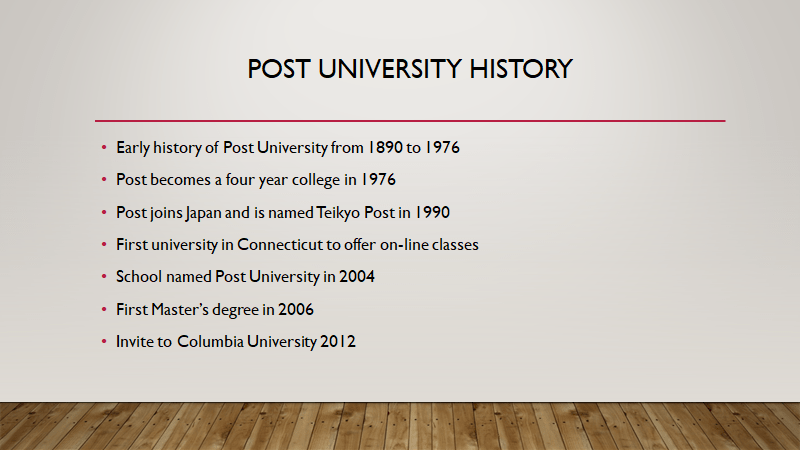
Post University has been an innovative school since being founded in 1890 by Henry C. Post. The school began as a small classroom and was called Matoon Shorthand School from (1890–1893) After this period the school became Bliss & Harrington’s Business College & School of Shorthand (1893–1897). With the school still evolving it changed again to Waterbury Business College (1897–1931) moving away from the shorthand concentrations. The school was finally labeled as Post College (1931-1939) and then Post Junior College of Commerce in 1939. Soon the school evolved again into Post Junior College in 1962 (Sembiante, 2014). The most significant change was Post College (1976–1990) when the school became a four-year college. The school continued to grow with the joining of Teikyo University from Japan in 1990. The school was renamed briefly to Teikyo Post University but in 2004 the school control was transferred again, and the school was renamed Post University. Even with all the Changes the university still progressed and offered their first master’s degree in 2006 but even more important Post was the first university in Connecticut to offer an on-line degree according to an article about post university (stateuniversity.com, 2019).
According to Post’s website, they were invited to Columbia University’s Teachers College to present on the future of education (Post University, 2012). Columbia was extremely interested in the on-line program and how they initiated hybrid courses which shows Post is ready to commit to changes to keep up with future educational needs. Today Post University is licensed by the state of Connecticut through the Office of Higher Education and has Accreditation by the state of Connecticut (Post University, 2019).
Trends in Education
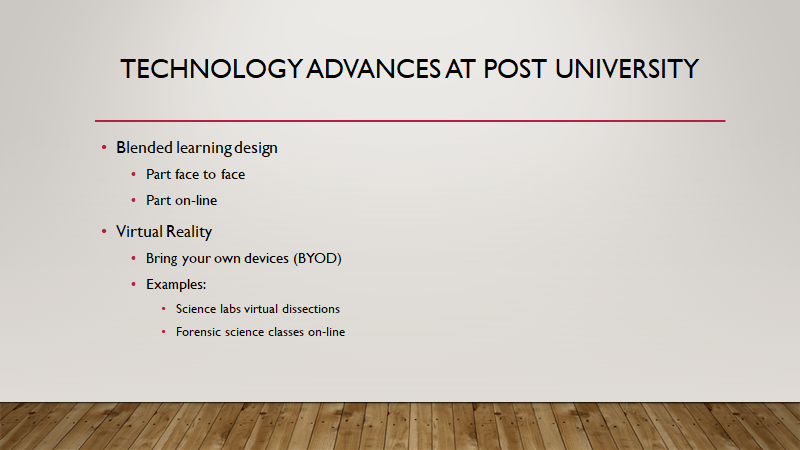
As seen by the history of Post University, they have been at the fore front of using technology in delivering their education to the public. Using the past as a prediction of the future, Post University should be staying at the cutting edge of using new technology in the classrooms. One of these future technology for the classrooms is using virtual reality to offer classes to students. It is possible for Post to become the first of its kind to use virtual reality in their teachings. Using wearable headgear to transport a student into any real-world setting this is possible with advancing technology. Post already uses augmented learning in their biology lab to dissect animals which saves on lab fees. According to Jacob H. Steffen, who co-wrote the article Framework of Affordances for Virtual Reality and Augmented Reality, the only flaws may be technology itself and the cost. (Steffen, Gaskin, Meservy, Jenkins & Wolman, 2019). Post has proven to be an innovator when it comes to education and should be able to make technology work in their programs. When reviewing the timeline in the article American Educational History: A Hypertext Timeline by E. Sass (2014), it is clear to see how Post University has stayed current with all the changes made in technology and other advances. Jacob Steffen also pointed out “from switches, dials, punch cards, mice, keyboards, and now touch screens, voice commands, and mid-air gestures, additional interaction choices allow for improved human-computer interaction” (Steffen et al, 2019, pg.684). This is where virtual reality can become the next logical step for Post University into the future for education. Instead of just bringing a laptop to class, students could adapt to the concept of bring your own device (BOYD) which could be an ocular headset used in virtual reality like mentioned by R. Riddell (2015).
Many opportunities will be available within the next five years and with technology changing every day, it is time to virtual reality classes. When paired with blended face to face education students can be introduced to a new way of class participation. A history class can take place in the city being discussed by the way of bringing a devise of virtual reality headsets, even medical students can observe a surgery, a criminal justice student can be at a crime scene this is all possible according to the 2016 Horizon Report (Johnson, Adams Becker, Cummins, Estrada, Freeman, & Hall, 2016). With the diverse learning area already in place Post is on a futuristic path of success to begin the next phase of learning.
Tech Trends
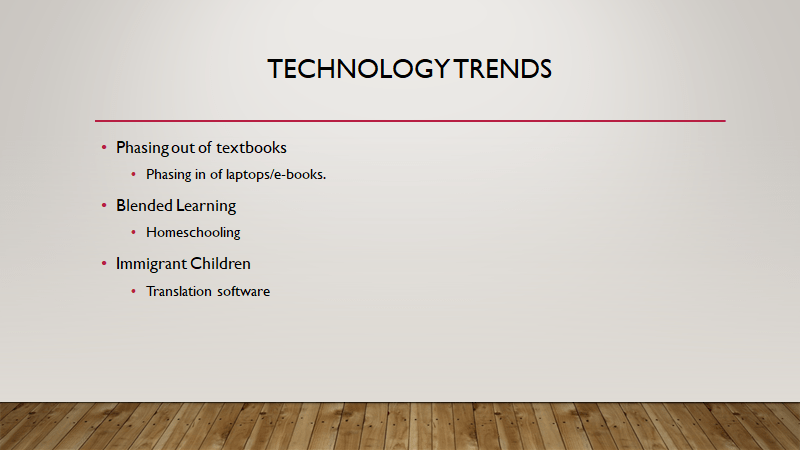
In the future, the textbooks can be phased out and the laptops phased in and when this happens there will no longer be a concern over low income educational areas because they will have the same equipment as upper-class neighborhoods. Presently Post University is already phasing out the paper textbooks and moving to either using e-books or links to articles. This makes it easier for students because they can enter a class late and start reading right away and not have to wait for the book or if they are remote in some place in the world, they will not have to wait for the mail to deliver the textbook. It has also kept the cost down for students. The electronic textbooks are much less expensive as the paper textbooks. This type of Blended learning is so important for the future in education (Briggs, 2013). Home schooling is also a key factor and on the rise with many families choosing to have one or two children and school at home due to overcrowding, educational complaints, and distance it is possible spending more money on schools is not worth it (A2Z Home Cools, 2018). One other trend is the impact of immigrant children that could enter the schools in the future. A recent poll found 53% of United States voters stated illegal immigrants should not be allowed in public schools (Daly, 2017) but if they are here all are to receive an education and what type of strain will this be on schools both financially and educationally.
Economic/Budget
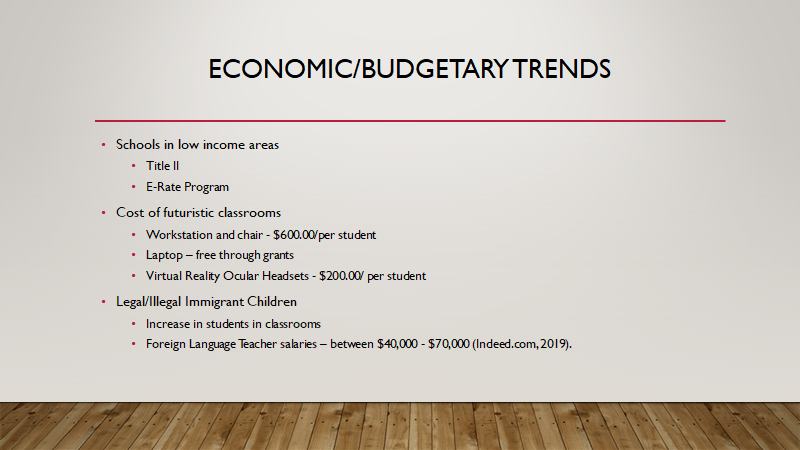
In 2016 Positive learning.com listed 7 ways to get grants for technology from donations of recycled computers to digital wishes (Positive Learning, 2016). The interesting information came from the Computers for Learning Program, which is a program where schools can receive donations of computers in k-12 nonprofit schools free of charge just my filling out an application to qualify (U.S. General Services Administration, n.d.). This program will cover how to get computers into schools no matter their economic or demographic capabilities. According to the 1965 Elementary and Secondary education act the federal government provides some funding under Title II (laws.com, 2017) and E-Rate program (Educationalcorner.com, 2019) makes sure schools in low income areas have access to internet and computers. There is funding by each state to defray costs of equipment besides being federally funded but is this enough.
To look at futuristic costs on one classroom it is needed to review the cost for one student first. The cost of one work center with a laptop and chair is $600.00 (Cuzzi DMED1 Sit-Stand Mobile Medical Computer Cart w/lockable Laptop Drawer & LCD Mount [online image], 2019) and if needed a virtually reality ocular headset is $200.00 (ClassVR, 2018). The laptops are funded by grants, and there will be a one-time fee for the work center and chair. This means one student would cost about $800.00. If a typical classroom had 30 students that means it would cost $24,000 to put this set-up in just one classroom. If you had a K-8 school that had three classes for each grade that would be 27 classes and at $24,000 each classroom it would cost $648,000 to equip every academic classroom in the school. This does not include the library, music, art, special education rooms, etc. This cost is assuming that the laptops are purchased through a grant and does not cost the school anything. Annual fees to upgrade software are usually a free download and schools today already have WIFI built into the budget. Very few states do not have some form of WIFI available. No matter the demographic, economic, or budgetary value each location can equip the future schools with the tools needed to support blended learning in the future.
With all the information out there for technology to be put into the schools one may ask if it is worth the expense there are many ideas about technology and many myths too. Will laptops in the schools be used for educational purposes or will students play games instead or can they both be combined for learning. A secondary economic trend may be in reference to the new influx of over 10,000 children that are in detention centers waiting for either release or deportation (U.S. Department of Health and Human Services, 2019). If they were all sent to public schools and universities tomorrow could cities and towns handle the overflow. If a futuristic work center is still $600.00 and now there is an influx of more needed where does the money come from. Foreign language teachers will need to be added with an average salary of $40,000 to $70,000 a year (Indeed.com, 2019).
If the work centers are available, the laptops would have language translation, but is that enough to warrant not hiring another educational teacher to speak the languages of the new students. Will educators know how to implement computer learning into the current curriculum and will the schools support the software or upgrades as they become available.
Demographic Trend
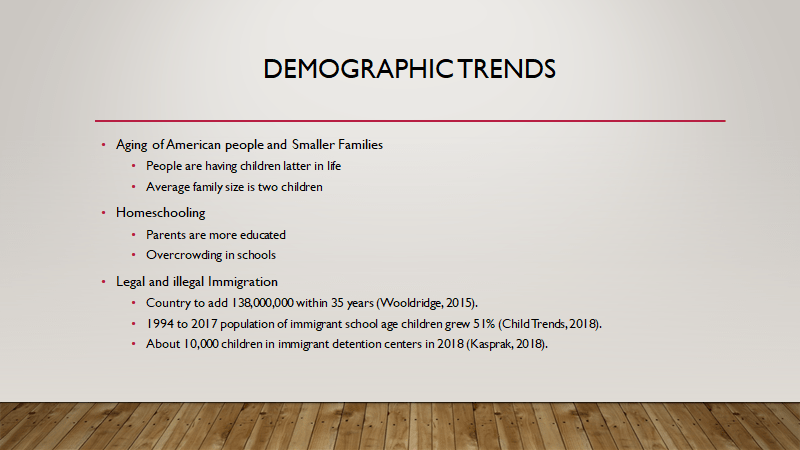
With the American people living longer but the average family only having two children is it possible the future of education is moving in a new direction of home schooling. Many higher educated parents are home schooling but there does not seem to be any differences in race or income in this factor (Coalition for Responsible Home Education, 2019). The largest demographical area for home schooling is in the south. One factor is new to the future and that will be how many children will be in the system of brick and mortar education. If homeschooling continues to decrease the population in traditional schools then the population of school age children, due to illegal immigration in traditional classrooms, will be on the rise. This will change the majority and minority ratio drastically. According to Frosty Wooldridge, a population activist, he states, “at the current rate of mass legal and illegal immigration our country expects an added 138,000,000 people within 35 years” (Wooldridge, 2015). From 1994 to 2017 the population of immigrant school age children k-12 grew by 51% with this group having only one foreign born parent (Child Trends, 2018).Consider the youth in detention centers now with both foreign parents being admitted to public schools. There were an estimated 10,000 unaccompanied children in 2018 in the centers (U.S. Department of Health and Human Services ,2019).With all the trends having equal importance the futuristic education system should prepare for change now.
Methodology/Futuring Techniques
Are universities today too involved with technology or not involved enough? When students finish high school and are applying to schools what are they looking for? Is there appeal in futuristic technology, blended or face-to-face learning or something totally different? The future of the educational system as it is known today may depend on how each school or university tries to be as progressive as possible. The futuristic vison of Post University is a great example of how it is possible to change from the simple beginnings in the 1800’s to today.
Currently, Post University is well versed with its own version of blended and face-to-face technology due to on campus and on-line education. The school offers augmented technology today and now is the time to introduce some futuristic scenarios to see if they will be cost effective and technologically possible. By adding new ideas, the school will remain attractive to the high school senior looking to further their education.
When futuring is addressed one can only imagine what life can be like 10 years from now but educational changes are necessary to keep up with technology or the students will have no reason to attend. There is a belief that the internet will still be largely in use, but the physical campus will still be needed (Fuscaldo , n.d.). On this notion a technological overhaul is in need starting with the classroom. The most basic change needs to be the classroom atmosphere.
Vision/Plan
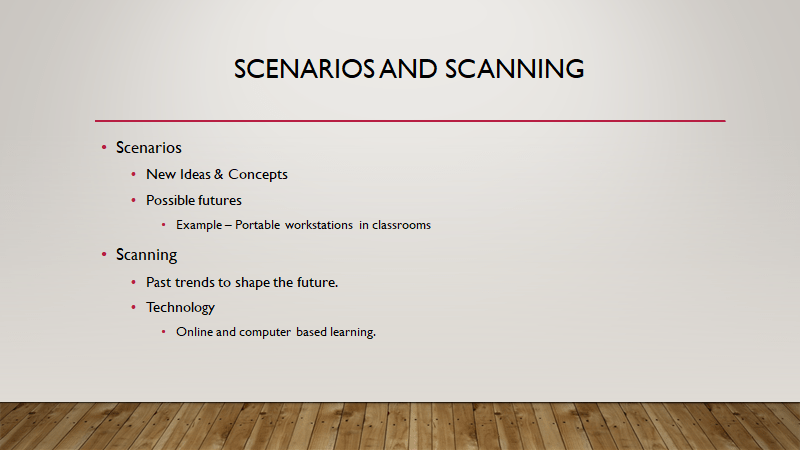
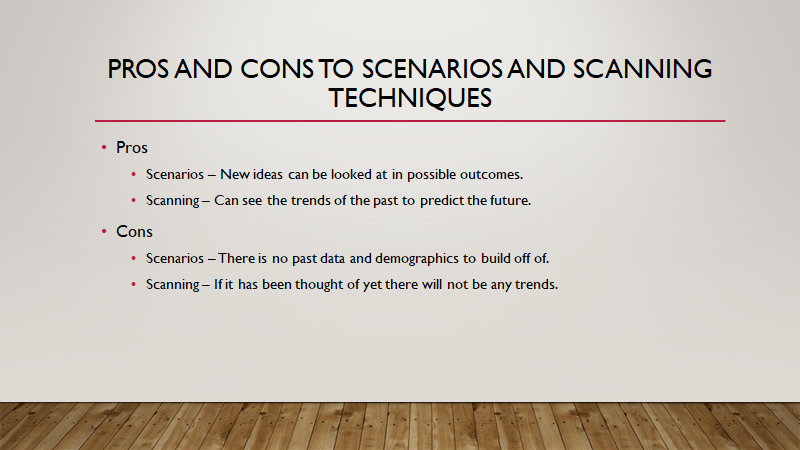
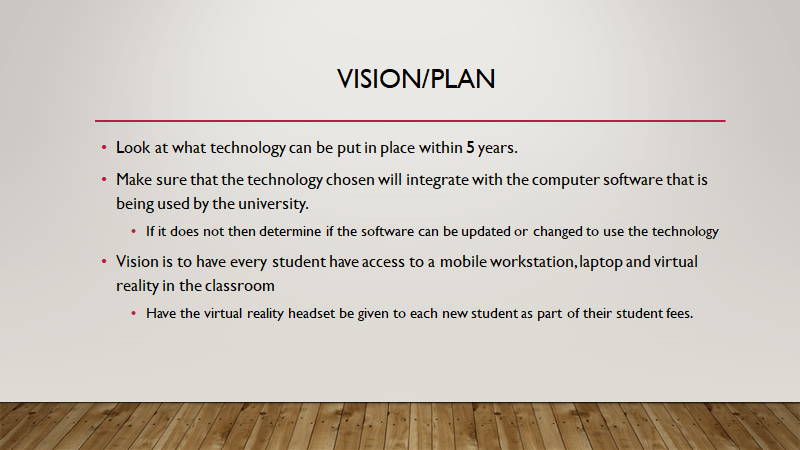
Vision and planning is the way to bring the future of technology in the classrooms to reality. To try and figure out what could happen one can use two different methods. The first is the scenario method which is looking at where one wants to go and make up ideas on how to get there. It will show where some of the problems might occur so you then can figure out the solutions. The other way is through the scanning method. This is looking at the past and present trends to figure out how they will keep advancing into the future.
Scenario:
Looking just 5 years ahead, desks can be replaced with portable workstations with laptops built right into them. With the blended system in place the convenience of having the technology in the classroom will make it easier to keep connected to students. This method can also be used in K-12 classrooms. Just grab a workstation and find a location to work.
The downfall to this may only be IT support for they systems or if the cost is too great (Coley, Cradler, & Engel, 1997) then the idea will not proceed. To compare the costs of some of the technology, ann example of a mid-grade laptop from 2014 will be compared to a mid-grade laptop from 2019. In 2014 the average cost of a laptop was $1299 for a 8gb ram, XPS 13 Core 15 processor, 128 GB SS, – example is The Dell XPS 13 Ultrabook (Paul, 2014) and in 2019 the average price is $1349 for 6 GB memory; 256 GB SSD storage and a larger screen – example is a Hewlett Packer Spectre x360 laptop (Hewlett Packer, 2019) The cost does not seem to change much in the 5 year span however to add a portable workstation and install the same laptop inside jumps each unit approximately $600.00 (Cuzzi DMED1 Sit-Stand Mobile Medical Computer Cart w/lockable Laptop Drawer & LCD Mount [online image], 2019) If there are 30 students per class each set up would have a price tag of $2,000. This may not seem like much for the future but in inner city schools or in some states where educational funding is not available it would leave them behind when it comes to futuristic education. The universities would not see the same issues to implement as K-12 so is it best to only implement the idea into higher education?
Once the workstations are in place other futuristic technologies could be implemented such as virtual reality programs being introduced to go along with the current curriculum. Using the same work station scenario add side rails for stability, an ocular headset, and program and it is ready to be implemented into the daily teachings. In an on-line class a student would just need to purchase one instead of a text book. An educator could be in a virtual reality world in Rome showing students architecture or inside of a crime scene looking for clues. The student would be able to be brought into the images instead of reading a screen or the flat pages of a book.
With the price of Higher education rising every year this may help defray some costs to the students by avoiding book purchases. Will the changes to the classroom entices students during University Visits? enrollment in the future it is unclear but to see if it is worth the simple change to a classroom it will be worth the cost since there was a decrease of 1.7% enrollment or 300,000 students from the spring of 2019 to the previous year (Nietzel, 2019).
Scanning:
In order to review the past and look ahead into the future a process called scanning may be used which looks at trends that have occurred, or perhaps are occurring, in the field. With this process future educators look back and see what ideas worked or did not work to see what has changed until today and now look ahead. They collect data with what had been found and compare with the technology changes in place today. Looking back at the last years the devices used in schools have changed and future educators and institutions need to figure out what the future might bring to keep up the pace.
Using this method you can try to figure out where technology is going. Forty years ago there was no home portable computers and phones were in a bag inside a car. There was no need to worry about issues with students being on technology in the classroom. Twenty years ago cellphones were used for talking on and some texting. Many students did not have these in classes. Today everyone has a cellphone and you even find kindergarteners bringing them to school. The cellphone is like having a small computer with you that you can look up anything you want. At the college level you have students on social media while in class. The next step then would be to take the idea that they are going to use the technology in class and put it to a learning format to bring the subject you are teaching across to the student.
Plan for Change
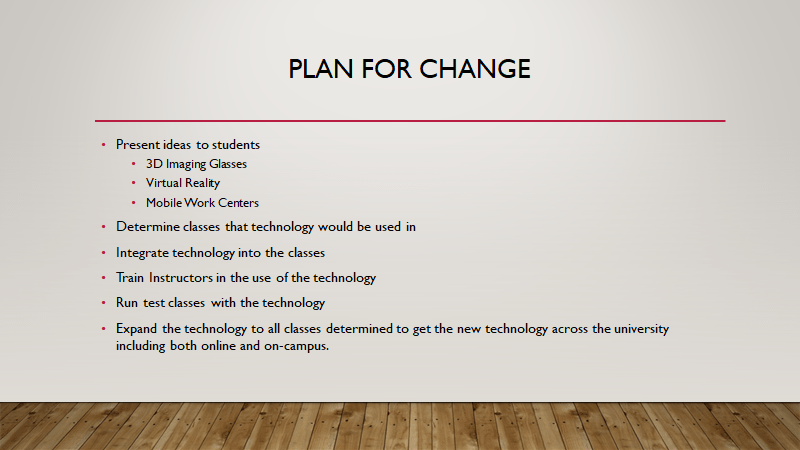
To be able to put the idea into reality one needs to first figure out if this is something that will be accepted and used by the students. To figure this out you need to put together a student work group. The group should be made up of students from across degree plans, to include both undergraduate and graduate students and involve both main campus and online students. Once it is determined who will be part of the student group, they will have to look at all the possible ideas that are being presented, like 3D imaging classes, virtual reality, and mobile work centers, and determine which ones should be implemented and in what order. Once this has been determined, the group needs to set up a meeting with the Leadership Team and/or the Board of Directors to set up a presentation on the group’s findings. This is being done to get the approval of administration to move forward with making the idea into reality. If they determine that it is a good idea, they will be the area that will determine the budget amount for the project moving forward. Upon approval of the Leadership Team and/or the Board of Directors the next step would be to arrange a meeting with the IT Department. This meeting will determine if the idea is even feasible with the current software programs and hardware system that the school is already using. If it is, then the next phase is for the IT Department to figure out the costs to make this happen and to see if it fits the given budget. If the idea does not fit into what is currently being used, then it needs to be determined what has to be done to make them compatable and the cost associated with that.
Once all the parts are in place to make the idea happen, the instructors that will be using the technology need to be trained. This process will include determining which classes will be the first classes to introduce the technology into them. Then the instructors that teach those courses need to go through a training on how to use the technology. The training should be both from a student’s point of view and the instructor point of view so the instructor can understand what the student is seeing. Now that everything is in place and the instructors are trained it is time to bring the program to the student body. The best way to do this is to introduce the technology in just a couple of courses as a trial run. This can determine if the concept and vision of the idea worked the way it was intended. It needs to be done both on campus and online because there could possibly be different issues that arise in the different modalities. If there are any issues then they are addressed before going live to the entire university.
Call to action
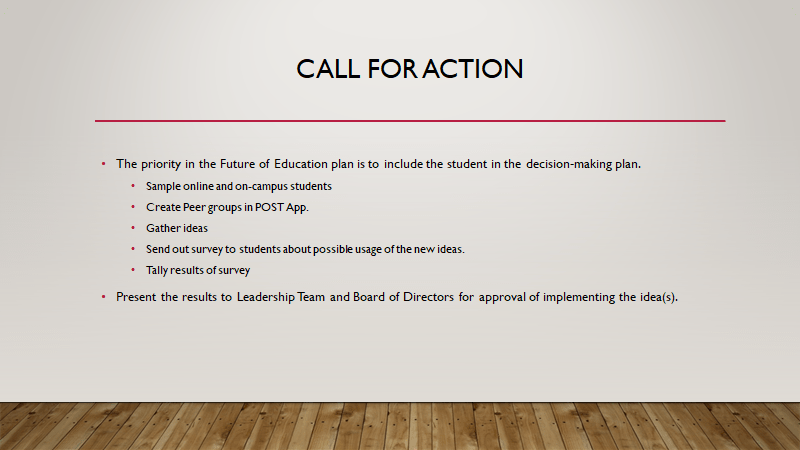
The priority in the Future of Education plan is to include the student in the decision-making plan. Since Post University “makes it personal” it is only natural to put together a sample group of both campus and on-line students to see which the most popular direction is to take first. To create the peer group, it would be possible to use the new app that was created this year (2019) and add a category for a new innovation idea for the future. Once some ideas about the future comes out of this focus group and with the help of the IT department, it would be easy to add a survey to the new app and also to send an email out to all students. Since most people use the app it would get results quickly. Once data is collected it needs to be tallied and then presented to the board members for approval. This will give all the new ideas in a report and the percentage of students that would be interested in the certain type of change. Since Post University is a private University it is up to the controlling board members to make the decision on how to proceed with the futuristic plan that is suggested.
References
A2Z Home Cools (2018, Dec). Numbers of Homeschoolers in the U.S. 2018-2019. HomeSchoolConnect. Retrieved from http://www.a2zhomeschooling.com/thoughts_opinions_home_school/numbers_homeschooled_students/
Briggs, S. (2013, Jul 29). 10 Emerging educational technologies & how they are being used across the globe [Blog]. Innovation Excellence. Retrieved from https://www.innovationexcellence.com/blog/2013/07/29/10-emerging-educational-technologies-how-they-are-being-used-across-the-globe/
Child Trends (2018). Immigrant children. Retrieved from http://www.childtrends.org/?indicators=immigrant-children
ClassVR (2018). ClassVR Pricing: Request a Quotation. Retrieved from http://www.classvr.com/contact/get-a-quote/
Coalition for Responsible Home Education (2019). Home School Demographics. Retrieved from https://www.responsiblehomeschooling.org/homeschooling-101/homeschool-demographics/
Coley, R. J., Cradler, J., & Engel, P. K. (1997). Computers and Classrooms: The Status of Technology in U.S. Schools. Policy Information Report. Educational Testing Services, Princeton, NJ Policy Information Center. Retrieved from http://www.ets.org/Media/Research/pdf/PICCOMPCLSS.pdf
Cuzzi DMED1 Sit-Stand Mobile Medical Computer Cart w/lockable Laptop Drawer & LCD Mount [online image]. Retrieved September 9, 2019 from https://www.computerdesksdepot.com/products/d-med1-height-adjustable-sit-stand-mobile-medical-computer-workstation-with-lock
Daly, C. J. (2017). The impact of immigrant children on America’s public schools: All Students Lose in Overcrowded Classrooms Taught by Overworked Teachers. NPG Forum Paper, Negative Population Growth, Inc.
Foreign Language Teacher salaries in the United States(2019, Oct 1). Retrieved from https://www.indeed.com/salaries/Foreign-Language-Teacher-Salaries
Fuscaldo, D. (n.d.). What will higher education look like in 5, 10, or 20 years from now?. Good Call Special Report: The future of higher education. Retrieved from http://www.goodcall.com/education/future-of-higher-education
Hewlett Packer (2019). HP Spectre x360 Laptop. Hewlett Packer Store. Retrieved from http://www.store.hp.com
Johnson, L., Adams Becker, S., Cummins, M., Estrada, V., Freeman, A., and Hall, C. (2016). NMC Horizon Report: 2016 Higher Education Edition. Austin, TX: The New Media Consortium.
Laws.com (2017). Elementary and Secondary Education Act. Retrieved from https://education.laws.com/elementary-and-secondary-education-act
Myths and realities about technology in K12 schools(2019). Retrieved from https://www.educationcorner.com/k12-technology-myths.html
Nietzel, M.T. (2019). College Enrollment, Spring 2019: The Downward slide continues. Forbes. Retrieved from http://www.forbes.com
Paul, I. (2014, Aug 28). The 10 best laptops of 2014 (so far). PCWorld. Retrieved from http://www.pcworld.com/article/2462654/the-10-best-laptops-of-2014-so-far.html
Positive Learning (2016, Feb 11). 7 ways to get funding and grants for technology in your classroom [Blog]. Retrieved from: http://www.positivelearning.com/blog/2016/2/11/7-ways-to-get-funding-and-grants-for-technology-in-your-classroom
Post University (2012, Feb.). Columbia University’s Teachers College invites Post University to present on the future of education [Web log post]. Retrieved from https://post.edu/blog/2012/02/columbia-universitys-teachers-college-invites-post-university-to-present-on-the-future-of-education
Post University (2019). Website. Retrieved on September 7, 2019 from http://www.post.edu
Riddell, R. (2015, Aug 27). These 10 trends are shaping the future of education. Retrieved from http://www.educationdive.com
Sass, E. (2014, Feb 13). American Educational History: A Hypertext Timeline. Retrieved September 7, from eds-resources.com
Sembiante, B. (2014, Feb 28). Reader Submitted: Post University seeking oldest living graduate. Hartford Courant. Retrieved on September 4, 2019.
Stateuniversity.com (2019). Post University. Retrieved September 5, 2019 from http://www.stateuniversity.com
Steffen, J. H., Gaskin, J. E., Meservy, T. O., Jenkins, J. L., & Wolman, I. (2019). Framework of Affordances for Virtual Reality and Augmented Reality. Journal of Management Information Systems, 36(3), 683–729. Doi:10.1080/07421222.2019.1628877
United States Census Bureau (2018, Mar13). Older people projected to outnumber children. Retrieved form http://www.census.gov
U.S. Department of Health and Human Services (2019). Latest UAC Data – FY2019. Retrieved from http://www.hhs.gov
U.S. General Services Administration. (n.d.) Computers for Learning Program. Retrieved on October 3, 2019 from https://computersforlearning.gov/htm/hp_eligibility.htm
Wooldridge, F. (2015, Mar 9). How many legal immigrants are too many?. Retrieved from http://www.newswithviews.com
EDU505 Final Presentation
 Lynette's Educational Journey