Final Presentation
Hello, I am Lynette Markey and today I will be discussing two online educational policies from Post University.
The purpose of the review is to take a look at the policy and what is its purpose.
Even more important to discuss is what challenges are faced with each policy.
The first policy we are taking a look at is how Post verifies student identity.
The reason why the institution needs to verify student identity is because it is required in order
to receive funding under The Higher Education Opportunity Act of 2008 (HEOA) which is a requirement of institutions who are receiving Title IV funding.
Basically, what that means is that funding will continue if the student’s identity is verified.
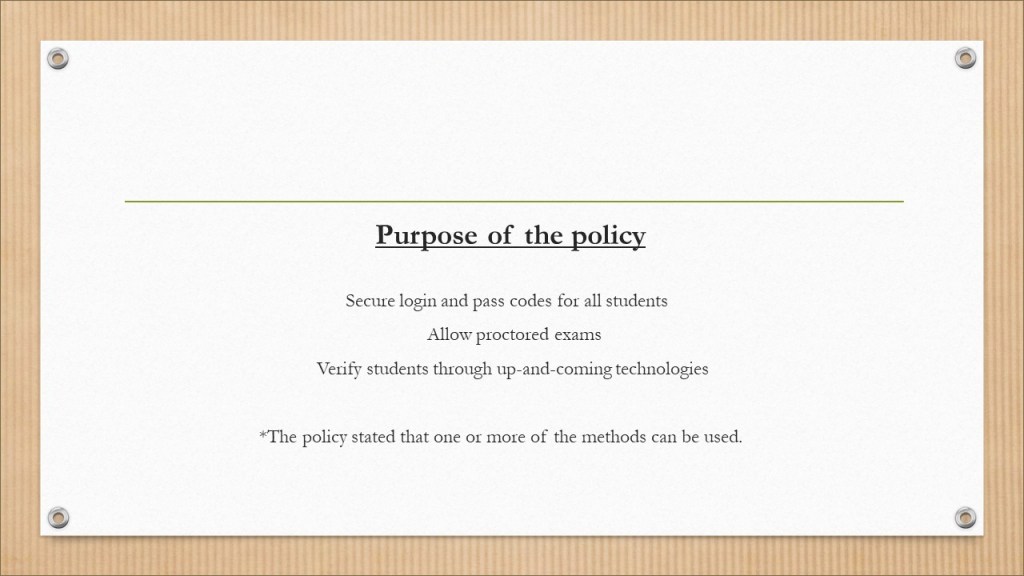
In order the meet the HEOA requirements, one or more areas must be met:
- Secure login and pass codes for all students
- Allow proctored exams
- Verify students through up-and-coming technologies
So now we know what the policy expects who is responsible to make sure it is compliant?
We know that the IT department issues the emails, logins, and passcodes but there are other people involved in this process.
The Provost or the Vice President of Academic Affairs, deals with compliance, along with the compliance officer.
The Deans and programs directors also make sure faculty are compliant,
but the faculty also plays a role in verification through proctoring the exams.
In a way instructor do verify students by way of a Keystroke recognition –
To put this simply, the way a person types, phrases used, or certain patterns used. Instructors can pick up on variances which may flag it as a different person completing the assignment.
If there is anything noticed that is unusual Safe Assign or other checkers could be used.
The second policy to discuss is Assessments and Surveys.
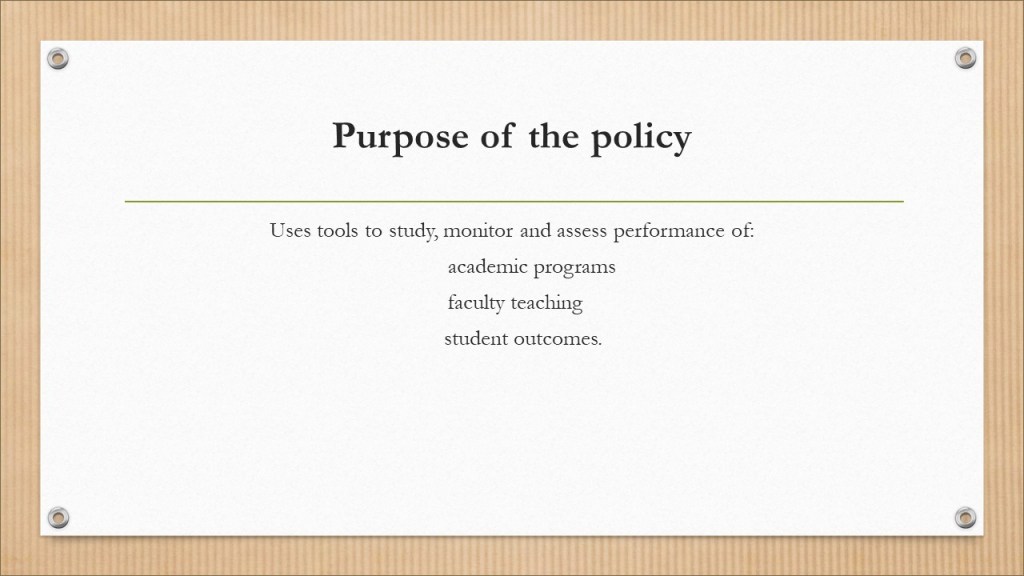
This policy applies to the tools used to study and monitor, as well as continuously assess performance of:
- academic programs,
- faculty teaching and
- student outcomes.
The tools used for assessment come from both external and internal sources
The methods used enable the university to analyze program performance as well as student satisfaction data with enrolled students as well as alumni.
The tools used also test the effectiveness of the program curriculum to evaluate the course and teaching practices.
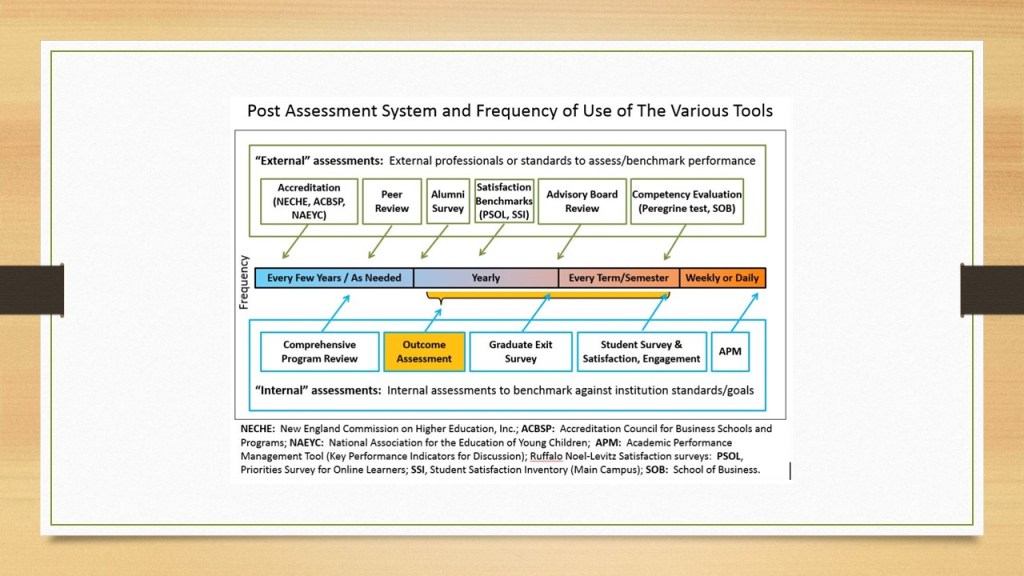
The chart shown is a process used to collect random samples and how often it is collected.
Information is taken from student work anonymously and assessed by the faculty of Post as well as outside professionals.
Not only is information taken from current students but as you can see in the top line there is also data from peer review, alumni, graduate exit surveys and student surveys –
- this just points out a few areas.
The point to make is that many tools are used to assess.
It is important to remember that the process used to collect this information does not affect student grades since samples are random. However student surveys are expected to be completed at the end of each course.
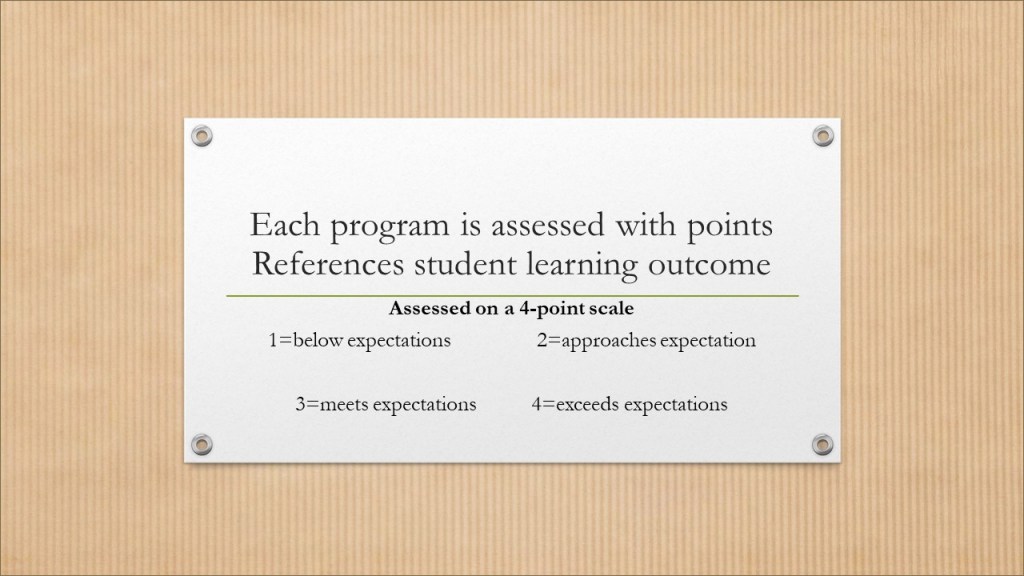
Each program is assessed with points in reference to the student learning outcome through the entire program as well. Students are assessed on a 4-point scale
1=below expectations
2=approaches expectations
3=meets expectations
4=exceeds expectations
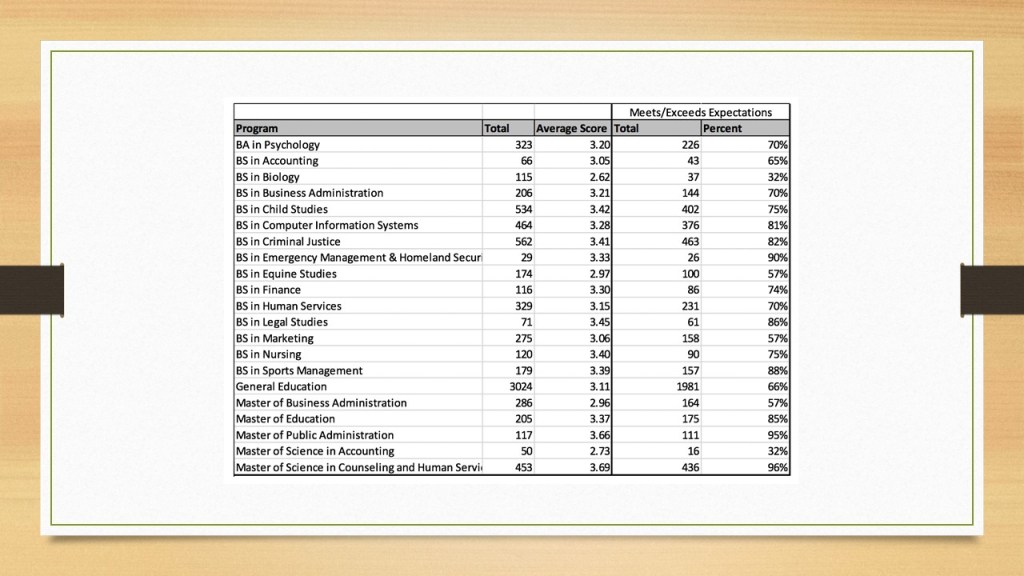
The last chart shows what happens to those prior scores.
Scores are consolidated and reviewed by the assessment committee and stakeholders.
Results are acted upon by school deans and programs chairs and programs are improved upon as needed.
The goal is for the students to rank as meet or exceeded levels of learning but after reviewing several areas some did not fare well like accounting and business administration
Data is consolidated and shared to inform the Public about Post and what it has to offer.
I have listed a reference slide, which I will leave up for a while, for review. Does anyone have any questions?
 Lynette's Educational Journey