Digital Citizenship is important for all generations to learn and master. The youth of today were born connected to technology, but do they know how to use it? Have they been taught the do’s and don’ts? Educators of today need to place emphasis on teaching students the Nine Themes of Digital Citizenship which are digital etiquette, digital communication, digital literacy, digital access, digital commerce, digital law, digital rights & responsibilities, digital health & wellness, and digital security (self-protection).
Why is this important? According to Holmes (2017), she mentions three main reasons. The first is to teach smart online behavior it is important that students learn how to cite other people’s work and never take credit for information as their own. The second is to prep students for the working world. Almost all jobs today is touched by technology. Students need to learn how to collect data, images, and resources which are proper for the workplace. The third is to learn empathy. I hope by now cyberbullying has slowed down, but youth need to learn online digital etiquette right away know that words hurt and how to be online appropriate.
By following the three mentioned principles of digital citizenship, Respect – Educate – Protect, one of my educational goals in life can be fulfilled which is to help equip students with what they need to master the online world they live in. I believe remembering three things is easier than nine and the following chart makes it so much easier.
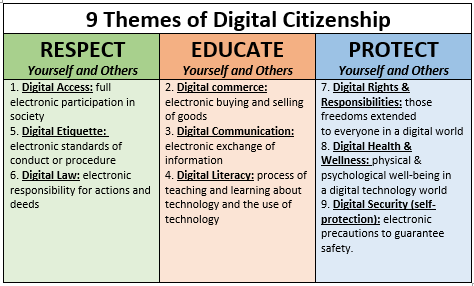

What is information privacy? The simple definition is it is a collection of your personal data stored on a computer. This information could be from medical records, banking, political, criminal, or even places of business. The question is how do we protect ourselves. This area falls under the 9th theme of digital citizenship about digital security.
Since the review of information privacy is defined if we look at copyrights this is a way to also protect your information privacy but in a different form. Dictionary.com defines copyright as “the exclusive right to make copies, license, exploit a literary, musical, or artwork, printed or audio video etc.” (Dictionary.com, 2020, para. 1). Unlike our privacy information there is a law that states the author of said pieces is protected for their lifetime and 70 years after death. Interesting thought, why can’t we copyright our identities? The answer is no! According to Gardiner (2016), a copyright is only given to a man-made creative work.
If everyone can just be responsible with technology and help students understand how to use the 9 themes of digital citizenship the future and partnership with the technological world will be bright. But not all of the themes have been perfected yet. I would like to see people be able to copyright their images as well as their personal information and it can only be seen or used without permission till long after we are gone.
Resources:
Dictionary.com (2020). Copyright. Retrieved on February 14, 2020 from https://www.dictionary.com/browse/copyright
Gardiner, T. (2016, Jun 14). Can you copyright your own face? [Blog]. Retrieved from https://www.quora.com/Can-you-copyright-your-own-face
Holmes, C. (2017, Oct 12). 3 Big Reasons You Need to Teach Digital Citizenship in CTE. Retrieved from https://www.aeseducation.com/blog/teaching-digital-citizenship-in-cte
Ingham, M. W., Kalamazoo, T. T., Macomb. J. H., & Shiawassee, V. C. (2015). 9 Themes of Digital Citizenship [chart]. Retrieved from http://21things4teachers.net/21-Things/08/index.html
Published on February 15, 2020 by Lynette Markey
 Lynette's Educational Journey