This Blog will be in reference to concepts and topics within information called “the game” and emotions that connect in social cognition as well as “the hard parts” within the game.
Perkins discusses 7 principles of learning to explain learning the whole game.
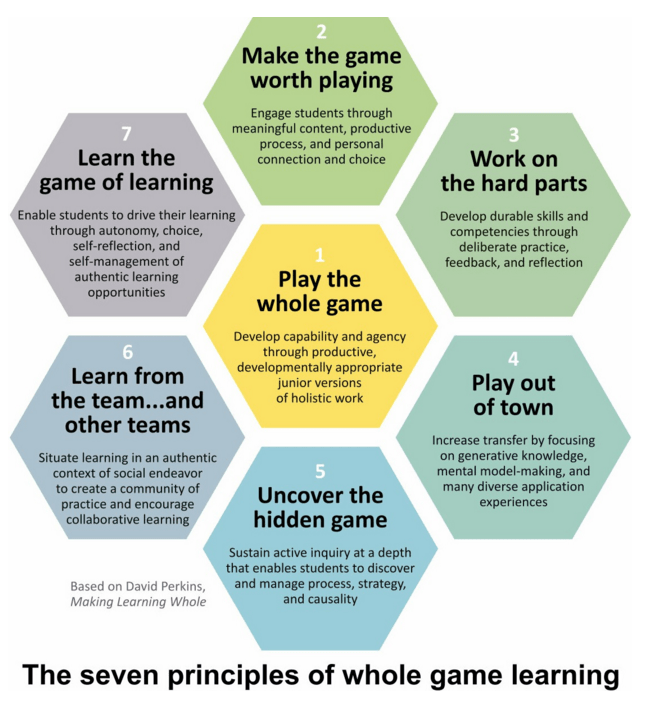
So, what exactly is the game and how does it connect emotionally to learners. Perkins refers to this analogy as a way student learn about something new and how to get better at doing it working through the hard parts and not skipping them. Seems like a bit of a run-on sentence to let me break it down. Perkins uses Baseball but I would like to reference my own personal experience with a Boy Scout unit my husband and I worked with. The overall game was to earn your eagle scout award by learning different pieces of information with many harder lessons (hard parts) along the way. It was necessary to keep the youth motivated and engaged in each activity.
Week after week the scouts would come to a meeting and be given more pieces of information but since they were not actually using the information given, they really were not playing the game yet Perkins calls this Elementitis or lots of information. (Perkins, 2009) Even though it is necessary to learn all about what is needed to succeed if it is boring or there is no connection to the real world the students will lose interest. It is only when we take the information out on a camping trip when one sees if anyone understands any of the material. Can the scouts remember what they learned and act on it?
So, we are on the trip and we now see the inert knowledge at work. The scouts know it and can remember what was told but some can’t connect the information to the hands-on task there for making the skill a hard part which needs to be mastered. As leaders we now need to use an example called PFSST Pace, Focus, Stretch, and stick. “This is the momentum in the game” (Perkins, 2009, pg 464). It is necessary to work out the problems to avoid leaving anyone behind in learning.
Peers play in important part in learning the whole game. Leaders are great at giving information on their own experiences but when a peer gives the same details the emotional connection between scouts seems to be better received. As stated from Perkins “teaching for understanding is a way of making the game worth playing” (Perkins, 2009, pg 65).
I found if a person needs to work through something difficult (a hard part) it is best to observe to see if the task has been grasped. If not, then what? Is it necessary to start over? This seems to be a great time for an ongoing assessment analogy. Youth really want to hear positive things all the time. It is possible to work through the hard parts with corrective and positive words such as, for example, “that looks great, but have you tried this?” I found this to be very appreciated. Communication always seems to be the key. Perkins suggests dealing with hard parts has to do with the communication of 3 key elements of clarification, appreciation, concerns and suggestions. (Perkins, 2009). This allows for a check on what is going on with clear feedback from the Leader and some suggestions to help with motivation.
The bottom line is that as educators we hope that information conveyed is transferred to memory but not all people are going to understand the whole game. Some may not be able to take in skills learned to use elsewhere in life, but some will. What we teach needs to be useful later and how it is transferred to memory goes with Perkin’s idea that teachers need “to prepare people with skills, knowledge, and understanding for use elsewhere” (Perkins, 2009, pg 114).
References:
Berman, M. (2012, Apr 12). Cubs Scouts Pitching a Pup Tent Without Instructions . Retrieved from https://youtu.be/dO7k7LpFP7g
Calkins, A. (2016, Jan 26). My Ways #2: Learning design as rich as you r definition of student success; The seven principles of whole game learning (image). Retrieved from https://www.nextgenlearning.org/articles/myways-2-learning-design-as-rich-as-your-definition-of-student-success
Perkins, D. (2009). Making Learning Whole: How Seven Principles of Teaching can Transform Education: Vol. 1st ed. Jossey-Bass
Published by L. Markey on August 1, 2020
 Lynette's Educational Journey