For my Blog I would like to discuss Open Educational Resources (OERs) and Multi-Device and Mobile Learning. I will review some examples of each and review how they are becoming trends in learning.
What is Open Educational Resources? The easiest way to describe this is free information, not copyright restricted, openly licensed text, images, or media that is useful for educational purposes. This applies to research, teaching, or learning. Some examples include open textbooks, videos, full courses, course materials, openly licensed, software and more. In today’s world of education OERs seem to be a normal way to teach especially when it comes to distant learning. Most of us have all copied an image and placed it in a paper like I have done below.
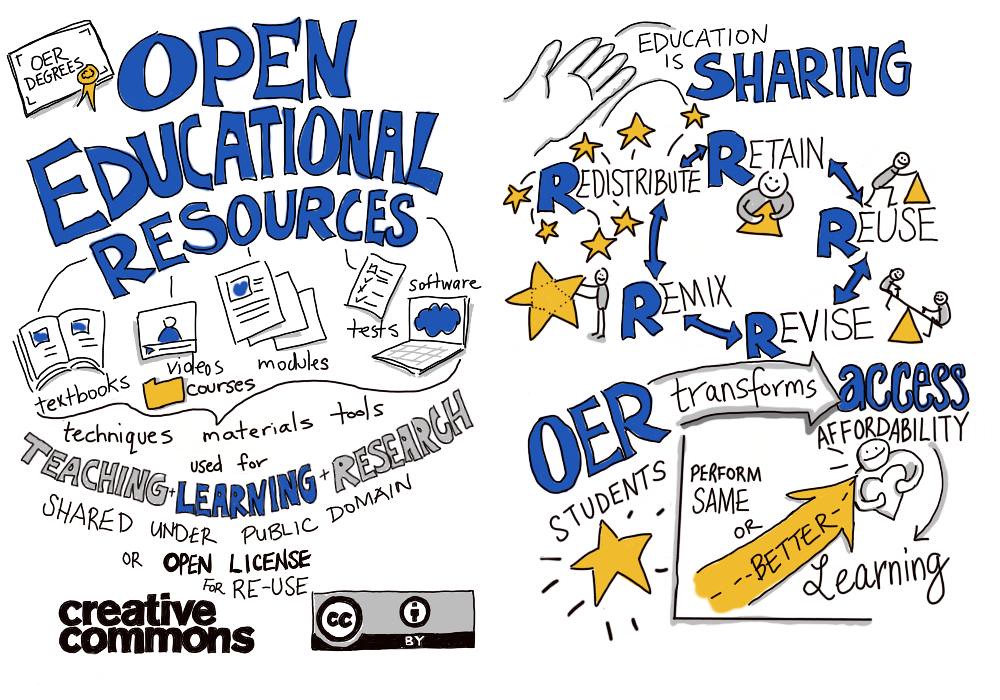
I did not have to pay for this image, but it is necessary to provide where the image comes from due to copyright law regulations, but I will get back to that topic later.
Returning to OER there are 4 different levels of OERs:
1 – open, no cost access such as reading a textbook or watching a video
2 – free/open sources such as using a video or book to obtain a certification
3 – the right to modify and add additional resources
4 – taking the improved resource that was created and republishing.
With this being noted it brings us back to the copyright information. Creative Common Licenses have been created so that the originator keeps the original copyright to the material but allows others to copy, share, and add their own information as well which refers to OER4. There are several layers to the licenses for creative commons as well:

Allows other to reorganize, change, build on, and redistribute works.

Is the same as above but is used for commercial purposes and is ok as long as you are given credit for what is used.

This one allows people to reuse our work, but it cannot be shared with others if changes are made. Credit is still given to your original

This one lets others reorganize, change, and add on to work non-commercially and their new works must acknowledge the originator and be non-commercial, but does not have to license derivative works.

Other people can reorganize, adapt, and build works non-commercially, as long as they give credit to you and then have to license their new creations

The last one has more restrictions because it only allows information to be downloaded. This one cannot be changed or used commercially and there must be credit given to the originator.
(Creative Commons, 2017)
I know that this seems to be confusing but in order to use information found withing the open educational resource would it is important to understand what is allowed and what is not when it comes to supporting the future of knowledge and how to access it properly. To summarize Creative Commons License or cc is used when a person wants to give others the ability to share, use and build on their original work. I need to add that the big problem I see with this is that others can profit from your work if the correct license is not selected so which one to choose is important.
Moving on to Multi-Device and Mobile Learning. Today almost everyone has a mobile device attached to them at all times so we review how this device can help support formal learning. Mobile learning or mLearning is augmented learning since learning is on-demand and the environment adapts to the learner. (Quin, C.N. 2011). mLearning is not delivery of a course but being creative with access to information which helps to learn, problem solve and innovate what we see. The GPS is an excellent example of mLearning since it enables us to see in real world place and time to solve the simple question of where we are going.
The technology of devices has changed rapidly over the years and I am old enough to remember each one. From the Palm Pilot to the smartphone they were all used with a processor with running memory and it seems like the only thing that has changed is the technology behind them. When thinking about the readings one piece of formal learning seems to stick out when it comes to Mobil learning and that would be the 7 Cs of learning.
- Choose what interests us
- Commit to doing the work
- Create by building experimenting and trying
- Crash which means to fail, learn and try again
- Copy by watching others and learning from them
- Converse or discussing with others to seek out feedback
- Collaborate again talk to peers about ideas
(Quin, 2011)
Mobile devices can help with the seven C’s, but I do not believe that they can replace real people. There is still a need for a facilitator to make learning successful. Only then can one truly see if comprehension of any topic exists otherwise all that is happening is another version of “knowledge dump” (Quin, C.N.2011) which in the classroom refers to “show up and throw up” information but updated to today’s world of technology which a version of download and go.
If one decides to use devices to help understand the world there are many ways to access the tools from sensors, apps, networking, even images but the real important view is content verses context. When it comes to mLearning it will be wonderful to get out of a classroom and participate in an activity where capturing a picture or opening a search engine to answer a question is possible but there is also a downside. Say we are on a field trip and there is no service, then what?
This video covers some myths about mobile learning.
Even though the video was made in 2015 it still seems to have relevant information today and refers to the same idea of content verses context.
This blog did not actually seem to fit from one subject to the next, but it was necessary to review what was addressed in the last two weeks of readings. Open Educational Resources are available to everyone that has a device to look them up whether a laptop or a smartphone. That is the only connection I can seem to make between the two units. The bottom line is technology is always changing and most of the access is free but remember to always cite what is being used for educational purposes to always cover yourself.
References:
Creative Commons (2017, Nov 7). About the Licenses. Retrieved from https://creativecommons.org/licenses/
Forsythe, G. (n.d.). OER is Sharing [Image]. Retrieved from https://brocku.ca/pedagogical-innovation/resources/open-educational-resources/
Quin, C.N. (2011). Designing mLearning: Trapping into the mobile revolution for organizational performance
Talent LMS (2015, Dec 18.) 6 Mobile Learning Myths Busted! Retrieved from https://youtu.be/ESQNcHbmzQQ
Published by Lynette Markey on October 17, 2020
 Lynette's Educational Journey