For my blog entry I would like to discuss topics explored in reference to Project Based Learning or PBL and the Flipped Classroom Learning. I will be reviewing some examples of each and how to apply them to a classroom setting.
What is project-based learning? My understanding is that a student understands and remembers more when there are hands on learning and not just lectures. PBL is filled with activities so students remain engaged in the subject and therefore remember more than just reading a book. It is my opinion that teachers may need more time to prepare when it comes to this type of learning which may be a negative However, since projects need to be created by the student, reviewed by the teacher, the class time is for questions which may reduce lesson prep time for educations. For students PBL may be more of an effective way to connect to what is being taught. My main question is then how do you asses if the subject was learned?
So why bother introducing project-based learning at all. Well, it is said that there are five keys to Rigorous to Project based learning.
- Real world connections
- Core to learning
- Structured collaboration
- Student driven
- Multifaceted assessments
(Edutopia, 2014)
Lathram, B., Lenz, B., Vander Ark, T. (2016, Aug 23.)
I do agree with given the opportunity to create projects instead of being lectured to. I believe it encourages students to work together not only does this method help with communication skills, but it also gives the teacher the ability to change rolls and become more of an adviser instead of a lecturer. As long as there are questions that are proposed prior to beginning the project to help facilitate understanding and some sort of assessment tool then I can this form of education working successfully.
The idea of Project Based Learning has been around for a long time. John Dewey introduced this idea in the 1800’s (Edutopia 2014) and today it is most commonly used in the STEM programs. Project Based Learning helps with boredom. “A study by Yale’s Center researchers from the Yale Center for Emotional Intelligence and the Yale Child Study Center found that nearly 75% of the students’ self-reported feelings related to school were negative.” (Belli, 2020, para 2). It is my opinion the use of project-based learning may take away some of the negative feedback and make learning fun.
The second part of my Blog has to do with Flipped Classroom Learning.
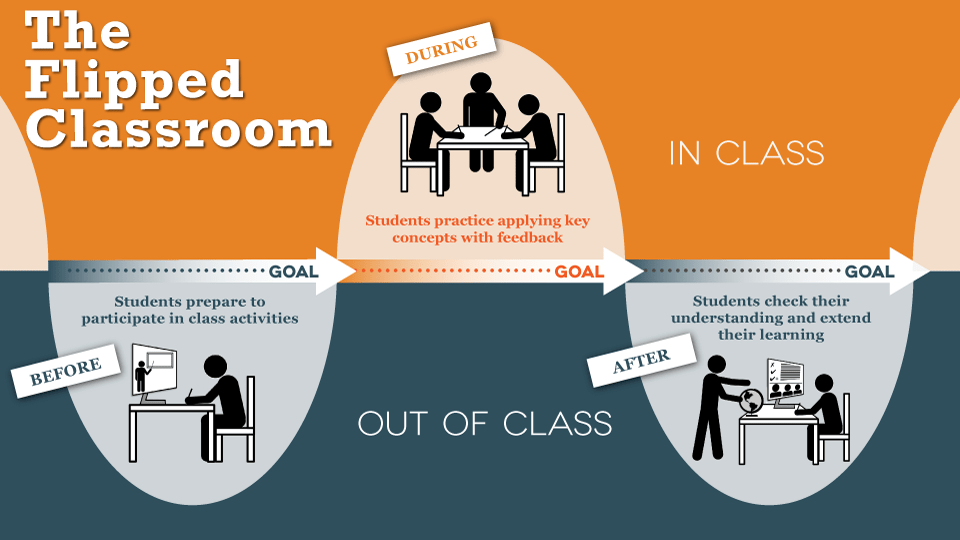
Unlike Project based where students work together in a classroom Flipped is when a student does most of the work at home and returns to the classroom with the completed work. The purpose of a flipped classroom is to allow brick and mortar time for questions and clarifications to work done at home and not just to sit in a room and be lectured to. There are pros and cons to this style of learning based on each individual person.
The following chart explains the differences between the two methods.
| Traditional Classroom | Flipped Classroom | |
| Classroom Role of teachers | Master of Knowledge and class | Instructor and simulator |
| Role of Students | Passive Learner | Active learner/researcher |
| Teaching methods in class | Teaching in class and doing homework after class | Pre-learning before class and discussing |
| Time distribution in class | Spending most of time in teaching | Spending most of the time discussing |
| Teaching contents in class | Teaching and imparting knowledge | Question-Answer study |
| Application of teaching methods | Presenting learning content | Autonomous learning and cooperative learning |
| Teaching evaluation | Paper test | Evaluation from multiple aspects |
I prefer this type of learning if a student must go to a brick and mortar school. The flexibility of not only the teacher but the student is important and as previously stated from Yale helps change the image of what school is in today’s society and most importantly to avoid boredom. The most important thing to remember in this type of learning is how to include Bloom’s Taxonomy. There is an interesting video explaining how to create, evaluate, apply, understand and remember that reviews how to “flip” the order of the pyramid to relate to Flipped Learning.
This is not different from the original image of Bloom’s Taxonomy we are all use to seeing but what is different is that it is possible to start from the bottom of the pyramid and work up. I found this fascinating and it seemed to make perfect sense.
In conclusion, my personal preference is the Flipped classroom learning and Project Based Learning seem to go hand in hand together.
References:
Belli, B. (2020, Jan. 30), National survey: Students’ feelings about high school are mostly negative, Yale News, Retrieved from https://news.yale.edu/2020/01/30/national-survey-students-feelings-about-high-school-are-mostly-negative
Deng, F. (2019). Literature Review of the Flipped Classroom. Theory & Practice in Language Studies, 9(10), 1350-1356.
Edutopia (2014, June 26). Five Keys to Rigorous Project-Based Learning retrieved from https://www.youtube.com/watch?v=hnzCGNnU_WM
Lathram, B., Lenz, B., and Vander Ark, T. (2016, Aug. 23). [Image] Preparing Students for a Project-Based World https://www.gettingsmart.com/publication/preparing-students-project-based-world/
Texas University Faculty Innovation Center (2013, Jul. 23) What is a flipped class? retrieved from https://vimeo.com/70893101
Published by Lynette Markey October 2, 2020
 Lynette's Educational Journey