For my first blog under EDU 639 there will be a review of units 1, 2, and 3 in reference what was addressed and what was learned from the readings.
Beginning with Unit 1 and the trends in online learning there was an introduction to nowcasting for distant education which predicts what is going to happen 2 to 3 years away (Wilson, 2012). There were 5 key trends that are shaping distant learning, which were:
- Advancing forms of knowledge, which has to do with how we learn to share new knowledge through free tools, apps, the cloud and the web.
- Assessing Learning Achievements has to do with how to whether information has been learned and how future distant learning may be changed to outcome based assessments which would be based on the core RRR of reading writing and arithmetic but there may be issues with special needs groups as well as bilingual people and where does the arts fit into the assessment.
- Making Learning Convenient and Accessible, speaks of how “remote learning is on the rise” (Wilson, 2012) and it is important to understand the pros and cons what the market place has to offer and who has the ability to use the technology.
- Reaching all Learners, which was most important to me since I live in a diverse area where not everyone has WIFI in their home so the technology to succeed is not available to all. The moral dilemma is real when it comes to reaching all students which is something that has been addressed during Covid with hotspots being set up, but it still does not put technology in every household.
- Engaging learners through Media and Design Experience. The last area of trends was the most informative when it comes to nowcasting since it addressed virtual reality, 3d imaging, high speed broad ban as well as social media. (Wilson, 2012).
It is my opinion that without the new emerging trends in education students would become bored.
The following video was from 2015 but seems to be incredibly accurate for 2020 as far as technology goes but the point of the video is to realize that even in 2015 the 5 key trends listed above were present.
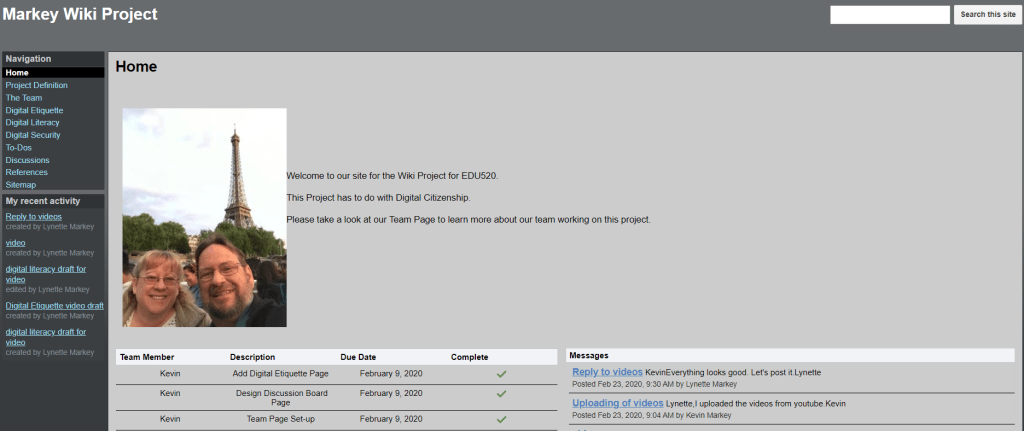
Unit 2 reviewed the Blended learning environment itself which focused on the use of Wikis which is a program that a user can freely create and edit a database similar to an LMS (Learning Management System). I personally have already used a Wiki for a previous class and found it to be a great example of blended distant learning. Students can use this program for a subject setup with collaboration within a group. There is the ability for feedback, questions, evaluations as well as group projects. I found it to be easy to use and was a nice way to work in a group however it is very easy to edit so access has to be restricted to an Editor.
This is what the site looks like:
Unit 2 also discussed blended learning models from Shea’s grounded model, McSporran and King blended learning method, as well as, Kahn octagonal model as well as rotational and flex models but there was so much information it was easy to get lost with all of the technical descriptions. What was most memorable from this area was the Rotation model which moved away from traditional brick and mortar to online within the classroom with stations that students move to throughout the day and rotate from class subjects. The flip side or Flex model is said to be the new way to learn. This is when a student moves at their own pace with an online curriculum this uses both technical and the teachers which are coaches, this seems to be the world we live which is a mix of how teachers are redeveloping the classroom with the combination of technology and face-to-face learning.
Unit 3 was about implementation of blended learning. The point was made that machines are available for information, but humans are still necessary for the emotional support. Both are needed to make blended learning work. There was a video referenced in this week’s activities, but it was from 2014 and spoke about iPod, really too old for todays trends. Mentions of downloaded textbooks and learning through technology seemed interesting but outdated. The best piece of information within week three came from the reading that answers questions about blended learning. The information included a video from the Modern Classroom Project which spoke about how teachers use the blended learning system and how students reacted to the change in curriculum.(Edutopia, 2019) Several points were addressed in reference to how the program works and how there is a reduction in anxiety due to a self-paced blended class. Learners are able to work in stations of video instruction, then to group activities where their peers help them to understand material and lastly take something called an exit ticket which is a mini quiz to see if the information was mastered. I believe this video could be viewed over and over. Each time you would see something new, and there is a section, under the video, that have most asked questions to help explain further how the program works (Farah & Barnett, 2019). To view the video please click on the following:
My opinion has always been that students should be self-paced and independent to the group. Teachers are valuable to help students to understand material and not just lecture so the blended trend of education works for the future.
References:
Al Jazeera (2015, Sep 16). 5 Technologies that will change classroom education . Retrieved from https://youtu.be/loFL5gT_m8I
Edutopia (2019, May 9) A student Centered Model of Blended Learning . Retrieved from https://youtu.be/zrR-KIoggf4
Farah, K. & Barnett, R. (2019, Aug 8). Answers to your blended learning questions. Retrieved from https://www.edutopia.org/article/answers-your-blended-learning-questions
Markey, K. D. & Markey, L. (2020) Markey Wiki Project. Retrieved from https://sites.google.com/site/markeywikiproject/
Newman, D. (2019, Aug 8). Digital Transformation Trends in Education for 2020 [image]. Retrieved from https://futurumresearch.com/top-digital-transformation-trends-in-education-for-2020/
Wilson, B. G. (2012) Trends and issues facing distant education a Nowcasting exercise. Trends in Issues in Distance Education 2nd ed.: International Perspectives, Chapter 3. Information Age Publishing
Published by Lynette Markey, September 16, 2020
 Lynette's Educational Journey